Monday, June 14, 2010
Finished report!
I finished writing my report! I still need to edit it, but it is done. And I learned how to make graphs on Microsoft Excel that actually work!

Sunday, June 13, 2010
Results!
Glue type Surface type Time
Trial no. -- weight held in grams
Average -- Average of three trials (in grams)
Wood glue Porous 30 min
Trial 1 -- 500
Trial 2 -- 1000
Trial 3 -- 1425
Average -- 975
Wood glue Porous 60 min
Trial 1 -- 1500
Trial 2 -- 1900
Trial 3 -- 1200
Average -- 1533.333
Wood glue Porous 180 min
Trial 1 -- 1500
Trial 2 -- 2000
Trial 3 -- 1000
Average --1500
Wood glue Non-porous 30 min
Trial 1 -- 125
Trial 2 -- 175
Trial 3 -- 125
Average -- 141.6667
Wood glue Non-porous 60 min
Trial 1 -- 75
Trial 2 -- 100
Trial 3 -- 100
Average -- 91.66667
Wood glue Non-porous 180 min
Trial 1 -- 210
Trial 2 -- 0
Trial 3 -- 400
Average -- 203.3333
Tarzan's Grip Porous 30 min
Trial 1 -- 150
Trial 2 -- 100
Trial 3 -- 300
Average -- 183.3333
Tarzan's Grip Porous 60 min
Trial 1 -- 300
Trial 2 -- 325
Trial 3 -- 200
Average -- 275
Tarzan's Grip Porous 180 min
Trial 1 -- 800
Trial -- 900
Trial 3 -- 850
Average -- 850
Tarzan's Grip Non-porous 30 min
Trial 1 -- 0
Trial 2 -- 100
Trial 3 -- 75
Average -- 58.33333
Tarzan's Grip Non-porous 60 min
Trial 1 -- 0
Trial 2 -- 50
Trial 3 -- 100
Average -- 50
Tarzan's Grip Non-porous 180 min
Trial 1 -- 50
Trial 2 -- 250
Trial 3 -- 150
Average -- 150
I couldn't get them to go into a table. All the numbers are weights in grams; the amount of water held.
Trial no. -- weight held in grams
Average -- Average of three trials (in grams)
Wood glue Porous 30 min
Trial 1 -- 500
Trial 2 -- 1000
Trial 3 -- 1425
Average -- 975
Wood glue Porous 60 min
Trial 1 -- 1500
Trial 2 -- 1900
Trial 3 -- 1200
Average -- 1533.333
Wood glue Porous 180 min
Trial 1 -- 1500
Trial 2 -- 2000
Trial 3 -- 1000
Average --1500
Wood glue Non-porous 30 min
Trial 1 -- 125
Trial 2 -- 175
Trial 3 -- 125
Average -- 141.6667
Wood glue Non-porous 60 min
Trial 1 -- 75
Trial 2 -- 100
Trial 3 -- 100
Average -- 91.66667
Wood glue Non-porous 180 min
Trial 1 -- 210
Trial 2 -- 0
Trial 3 -- 400
Average -- 203.3333
Tarzan's Grip Porous 30 min
Trial 1 -- 150
Trial 2 -- 100
Trial 3 -- 300
Average -- 183.3333
Tarzan's Grip Porous 60 min
Trial 1 -- 300
Trial 2 -- 325
Trial 3 -- 200
Average -- 275
Tarzan's Grip Porous 180 min
Trial 1 -- 800
Trial -- 900
Trial 3 -- 850
Average -- 850
Tarzan's Grip Non-porous 30 min
Trial 1 -- 0
Trial 2 -- 100
Trial 3 -- 75
Average -- 58.33333
Tarzan's Grip Non-porous 60 min
Trial 1 -- 0
Trial 2 -- 50
Trial 3 -- 100
Average -- 50
Tarzan's Grip Non-porous 180 min
Trial 1 -- 50
Trial 2 -- 250
Trial 3 -- 150
Average -- 150
I couldn't get them to go into a table. All the numbers are weights in grams; the amount of water held.
Saturday, June 12, 2010
Experiment is Done!
All 36 trials are done (2 glues x 2 surfaces x 3 drying times x 3 trials).
The good news is my bath is usable again!
The bad news is I still have to write my report!
Is it nerdy that I'm actually looking forward to doing the poster? I had this really fun idea for it!
The good news is my bath is usable again!
The bad news is I still have to write my report!
Is it nerdy that I'm actually looking forward to doing the poster? I had this really fun idea for it!
Wednesday, June 9, 2010
Experiment Photos
I'm sick today, but I thought it was time for more experiment photos. 


The two glues for testing.

The Official Experimental Set-Up

The Official Experimental Timekeeping Device, which may be haunted, due to its tendency to randomly play the radio and refuse to turn off.

The Official Experimental Bit of Paper for Putting the Matchsticks/Nails on to Make Sure They're Exactly 2cm Apart. This has become maths grid paper as it's easier to measure out.

Tarzan's Grip/non-porous/60 min Trial 2 (nicely due at exactly 5pm)

The Leaning Tower of I Was Bored, with pen for size comparison/strength demonstration.
I hope the line breaks work out okay in this, as I had to do them with HTML because the text wrapping is messy.
Saturday, June 5, 2010
Trial 1 results!
Trial 1 took place over several days*. A few things had to be redone, due to alarms not going off, missing the time when it was due to be tested etc. But overall it worked out well and all the glue held more than I expected (I thought glue was pretty weak, despite the guy on Better Homes and Gardens always saying "now the nails are just there to hold it till the glue dries").
The two glues I'm testing are wood glue, designed for porous surfaces only, and Tarzan's Grip, designed for all surfaces.
Anyway, these are the results. I don't know how to do a table on Blogger.
WOOD GLUE
Porous
30 min -- 500g
60 min -- 1500g
180 min -- 1500g
Non-porous
30 min -- 125g
60 min -- 75g
180 min -- 210g
TARZAN'S GRIP
Porous
30 min -- 150g
60 min -- 300g
180 min -- 800g
Non-porous
30 min -- 0g (did not hold weight of empty bag)
60 min -- 0g (held empty bag but collapsed as I was getting the funnel into position)
180 min -- 50g
The wood glue has a tendency to snap while I'm refilling the 500mL measuring jug, which is why it has so many exact 500g increments. I think it can sometimes handle a certain amount of weight, but not for too long. This experiment could be improved if I had something that could pour continously and measure the flow, but I don't have a meter of this sort.
*I'm going to email Ms Zhang to find out whether this is bad.
The two glues I'm testing are wood glue, designed for porous surfaces only, and Tarzan's Grip, designed for all surfaces.
Anyway, these are the results. I don't know how to do a table on Blogger.
WOOD GLUE
Porous
30 min -- 500g
60 min -- 1500g
180 min -- 1500g
Non-porous
30 min -- 125g
60 min -- 75g
180 min -- 210g
TARZAN'S GRIP
Porous
30 min -- 150g
60 min -- 300g
180 min -- 800g
Non-porous
30 min -- 0g (did not hold weight of empty bag)
60 min -- 0g (held empty bag but collapsed as I was getting the funnel into position)
180 min -- 50g
The wood glue has a tendency to snap while I'm refilling the 500mL measuring jug, which is why it has so many exact 500g increments. I think it can sometimes handle a certain amount of weight, but not for too long. This experiment could be improved if I had something that could pour continously and measure the flow, but I don't have a meter of this sort.
*I'm going to email Ms Zhang to find out whether this is bad.
An unscientific wasp
Picture the scene...
I am sitting in my room, laying out more experiment trials. My bin contains at least 100 000 matchsticks, nails, and bits of paper covered in glue dots. A Dr Karl podcast is on pause beside me so I can more fully focus on the delicate process of pasting matchsticks together.
Suddenly, a loud buzzing interrupts my gluing. WASP!!!!!!!!!!!!!!!!! I run out of the room, leaving wood glue/matchsticks, 30 min (trial 2) unfinished.
The wasp was deterred by some spraying, so I have resumed my experiment. More on that in a second.
I am sitting in my room, laying out more experiment trials. My bin contains at least 100 000 matchsticks, nails, and bits of paper covered in glue dots. A Dr Karl podcast is on pause beside me so I can more fully focus on the delicate process of pasting matchsticks together.
Suddenly, a loud buzzing interrupts my gluing. WASP!!!!!!!!!!!!!!!!! I run out of the room, leaving wood glue/matchsticks, 30 min (trial 2) unfinished.
The wasp was deterred by some spraying, so I have resumed my experiment. More on that in a second.
Tuesday, June 1, 2010
Wood glue is quite amazing...
Wood glue has become the first glue to be tested on the "wrong" surface -- a nail (it's meant for porous surfaces). It held on well considering, bearing 125 grams plus the weight of the bag*.
*This is not included as the bag weighs the same for all tests; hopefully it won't break or I'll have to look for an identical one.
*This is not included as the bag weighs the same for all tests; hopefully it won't break or I'll have to look for an identical one.
Sunday, May 30, 2010
Another variable: time
I did a test run of my experiment and took these pictures (the stepladder in the bath was my Dad's idea).


This is the stepladder in the bath, without any sticks/weights on it yet.

These are the crosses (they have two rungs so it doesn't rotate), drying. The paper is marked with the approproate distance apart for the rungs, and the time they were made.

This is the setup with the bag (below) and matchsticks.
I was checking the setup worked properly. This afternoon I'll do the first actual experiment (with the times measured out).
Wednesday, May 12, 2010
Experiment Design Model
I haven't bought the stuff for my experiment yet, so I decided to make a quick cardboard model to illustrate the design.


The surfaces are marked A and B (the A is covered; it's the orange one underneath). The plastic bag is hanging. This model is not to scale.
In other news... I finally got a background image to work on my blog!
Tuesday, May 11, 2010
Method
Materials (amount required for one repetition of experiment)
• 8 plywood planks
• 8 plastic planks
• Heat glue
• Plastic (solvent) glue
• PVA wood craft glue
• Glue stick (designed for use on paper)
• 8 plastic garbage bags
• 250mL measuring cup
• Water
Method
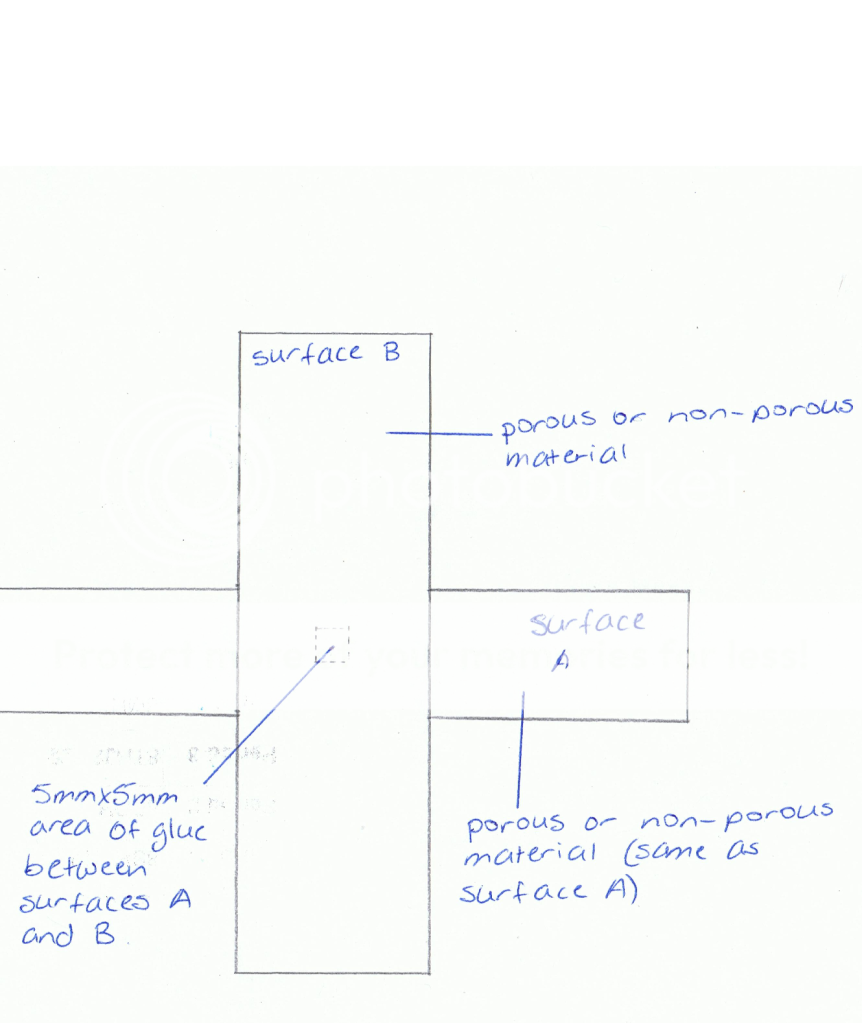
1. Make four wood crosses and four plastic crosses, as in figure 1, each joined at the centre with a 5mmx5mm area of the glue to be tested. Write on each cross which glue was used to make it.


• 8 plywood planks
• 8 plastic planks
• Heat glue
• Plastic (solvent) glue
• PVA wood craft glue
• Glue stick (designed for use on paper)
• 8 plastic garbage bags
• 250mL measuring cup
• Water
Method
1. Make four wood crosses and four plastic crosses, as in figure 1, each joined at the centre with a 5mmx5mm area of the glue to be tested. Write on each cross which glue was used to make it.

Click here for larger version of figure 1.
2. Leave the crosses to dry for 48 hours without stressing the joins.
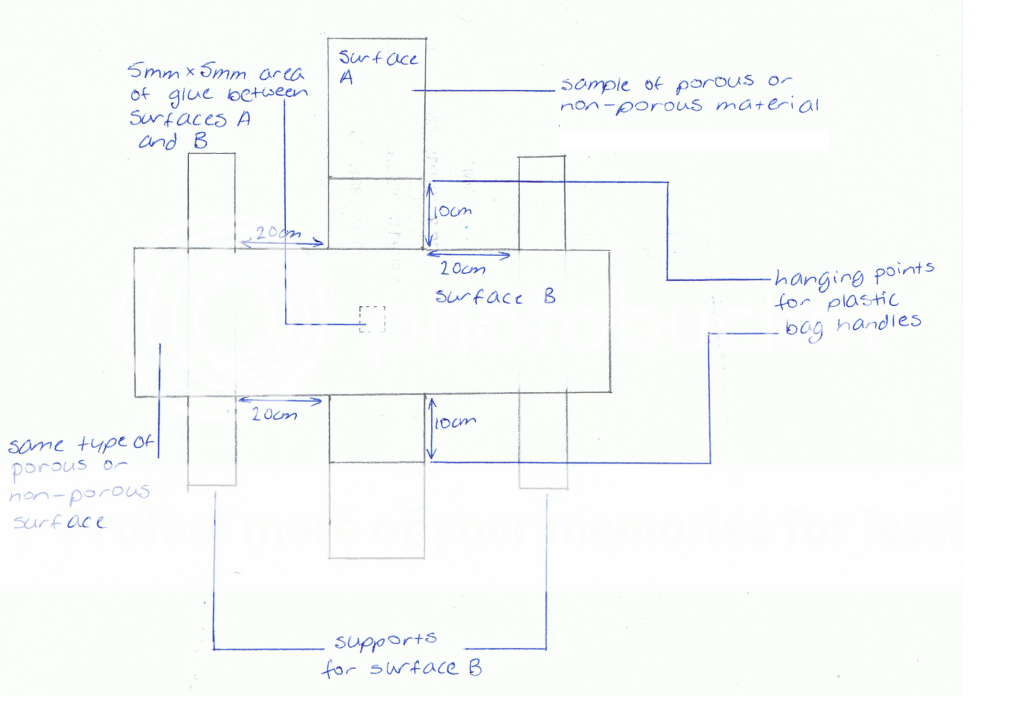
3. Set up equipment as per figure 2, with one cross.
2. Leave the crosses to dry for 48 hours without stressing the joins.
3. Set up equipment as per figure 2, with one cross.

Click here for larger version of figure 2.
4. Hang a plastic garbage bag, with one handle over each point marked in figure 2.
5. Pour 100mL of water into the plastic garbage bag.
6. Continue pouring water into the bag in 100mL increments until the glue bond breaks completely at the centre of the cross.
7. Record the amount of weight supported by the glue bond before breaking.
8. Repeat steps 1-7 for all glue and wood types.
9. Repeat steps 1-8 on at least two separate occasions.
4. Hang a plastic garbage bag, with one handle over each point marked in figure 2.
5. Pour 100mL of water into the plastic garbage bag.
6. Continue pouring water into the bag in 100mL increments until the glue bond breaks completely at the centre of the cross.
7. Record the amount of weight supported by the glue bond before breaking.
8. Repeat steps 1-7 for all glue and wood types.
9. Repeat steps 1-8 on at least two separate occasions.
Information about Method
I got approval for the glue experiment, so that's what I'm doing now. The next post will be my method.
My Dad thinks that the glues, when put on the "right" surface, could hold kilograms. Which kind of makes my 10mL syringe obselete. I'm trying to figure out how to overcome this; probably by adding water in 100mL increments. Another way to change this will be to use less of each type of glue, over a smaller area, to reduce the amount of weight required to break the bond.
Another problem is how to attach the bag to the hook. Obviously this bond needs to be stronger than the glue! I think I may use a ceiling hook designed for about 7kg.
My Dad thinks that the glues, when put on the "right" surface, could hold kilograms. Which kind of makes my 10mL syringe obselete. I'm trying to figure out how to overcome this; probably by adding water in 100mL increments. Another way to change this will be to use less of each type of glue, over a smaller area, to reduce the amount of weight required to break the bond.
Another problem is how to attach the bag to the hook. Obviously this bond needs to be stronger than the glue! I think I may use a ceiling hook designed for about 7kg.
Sunday, May 9, 2010


Saturday, May 8, 2010
Changing the experiment
After some consideration, I have decided that the petrol consumption experiment involves too many variables that cannot be controlled adequately. I had an idea for a new experiment investigating the durability of different types of glue (wood, paper, waterproof, glue stick) in bonding different types of surfaces (porous and non porous). I will have to write up a formal method for this experiment.
The basic plan is to bond two surfaces with glue, wait for the glue to dry, and then incrementally increase the weight on the bond until it breaks.
Dependent variable: type of surface (porous/non porous), type of glue
Independent variable: Amount of weight held before the bond breaks
Controlled variables:
-- Surface area of glue: 1cm2
-- Amount of glue: 0.5mL (Luckily I have loads of tiny measuring syringes from medicating sick guinea pigs)
-- Weight of container... probably some sort of plastic bag, maybe a Snap-Lock sandwich bag?
-- Weight placed into bag: Water in 5mL (5g) increments
-- Amount of time glue allowed to dry before being tested: Probably 24-48 hours; I'll check the "recommended drying" times on glues and use the longest one.
-- Weather conditions of testing: Humidity, temperature etc. This probably won't be a problem as they'll all be in the same area, on the same day. The experiment will also be repeated several times on different days.
I think this experiment will be possible to carry out and control.
The basic plan is to bond two surfaces with glue, wait for the glue to dry, and then incrementally increase the weight on the bond until it breaks.
Dependent variable: type of surface (porous/non porous), type of glue
Independent variable: Amount of weight held before the bond breaks
Controlled variables:
-- Surface area of glue: 1cm2
-- Amount of glue: 0.5mL (Luckily I have loads of tiny measuring syringes from medicating sick guinea pigs)
-- Weight of container... probably some sort of plastic bag, maybe a Snap-Lock sandwich bag?
-- Weight placed into bag: Water in 5mL (5g) increments
-- Amount of time glue allowed to dry before being tested: Probably 24-48 hours; I'll check the "recommended drying" times on glues and use the longest one.
-- Weather conditions of testing: Humidity, temperature etc. This probably won't be a problem as they'll all be in the same area, on the same day. The experiment will also be repeated several times on different days.
I think this experiment will be possible to carry out and control.
Sunday, May 2, 2010
Back from holidays and starting experiment
I've finally returned from holidays so I can start posting on my blog again and doing my experiment. Un(?)fortunately I haven't been on any long drives yet, but this should (un)fortunately change. Also, I found out that when I turn 16, I'll be able to start learning to drive, so if I wanted I could be extra hands on with this experiment! Maybe that would be a little too dangerous...
Thanks to Izzy for pointing out some more variables I need to control -- whether the car airconditioning and stereo are on or off, which could burn extra petrol. Since it's winter, I'll get us to turn them off all the time that's being recorded, just to make it simpler.
Thanks to Izzy for pointing out some more variables I need to control -- whether the car airconditioning and stereo are on or off, which could burn extra petrol. Since it's winter, I'll get us to turn them off all the time that's being recorded, just to make it simpler.
Wednesday, March 10, 2010
Fuel consumption experiment
I finally have a good idea that will probably work. I am planning to investigate the relationship between the average speed of a car and the fuel consumption. Data will be collected from the trip computer records on our car.
Independent variable: average trip speed (km/h)
Dependent variable: fuel consumption per 100km
The car makes a number of journeys on many different routes, which will allow collection of large amounts of data.
Aim: to investigate whether it would be more environmentally friendly to build a motorway through the city, or to maintain the current system of minor roads.
Hypothesis: As the average speed increases, the fuel consumption per 100km will decrease, then begin to increase as air resistance becomes a factor.
The method will involve investigating the fuel consumption of the car over journeys generally (eg. travelling to school, work, and sport), with average speeds, and comparing this to the fuel consumption when driving on routes where more than 50% of the journey's distance takes place on a motorway. This will be quite practical as we frequently drive relatively long distances within the city both along regular roads and also along motorways.
The result of the experiment will be to see whether including more motorways in metropolitan road infrastructure would decrease fuel consumption among family vehicles.
Some variables that need to be controlled: the amount of weight carried by the car will vary sometimes, but this should not affect the experiment as it is averaged out. The only time that this may affect results is if the amount of weight in the car was consistently different for trips on motorways and regular roads.
Independent variable: average trip speed (km/h)
Dependent variable: fuel consumption per 100km
The car makes a number of journeys on many different routes, which will allow collection of large amounts of data.
Aim: to investigate whether it would be more environmentally friendly to build a motorway through the city, or to maintain the current system of minor roads.
Hypothesis: As the average speed increases, the fuel consumption per 100km will decrease, then begin to increase as air resistance becomes a factor.
The method will involve investigating the fuel consumption of the car over journeys generally (eg. travelling to school, work, and sport), with average speeds, and comparing this to the fuel consumption when driving on routes where more than 50% of the journey's distance takes place on a motorway. This will be quite practical as we frequently drive relatively long distances within the city both along regular roads and also along motorways.
The result of the experiment will be to see whether including more motorways in metropolitan road infrastructure would decrease fuel consumption among family vehicles.
Some variables that need to be controlled: the amount of weight carried by the car will vary sometimes, but this should not affect the experiment as it is averaged out. The only time that this may affect results is if the amount of weight in the car was consistently different for trips on motorways and regular roads.
Ideas and why they were discarded
I realised I have had a number of ideas for my research project, most of which I have discarded.
1. Measuring amount of metals in soils and seeing whether this increases near roads. The independent variable would be the distance from the road, and the dependent variable would be the amount of metal. This would have been a good experiment, but it might be hard to measure the exact distance between roads, and there could be other variables such as the number of cars on the particular road, and the natural type of soil. Another practical consideration was the method of isolating metal from the soil: using magnets would only collect magnetic metals.
2. Investigating the relative success rates of various types of memorisation. The independent variable being the type of memorisation (listening, reading, looking at pictures) and the dependent variable being the number remembered correctly from the list. However, this would be difficult to find enough people, and other variables such as age and gender may be unevenly distributed among the sample groups. It might be hard to make a hypothesis, as it is difficult to find a starting point on what is likely to be the most successful method.
3. Does applying topical antiseptic/antifungal cream to a plant prevent or treat disease? The independent variable would be the type of cream used, and the dependent variable would be how long the plants survived before being overcome by the disease, or, if using baby plants, what height they grew to still having the disease.
This would be difficult to measure accurately, as the variables would be hard to control, including the initial dose of disease introduced to infect the plant (I was thinking of grinding up infected leaves from other plants and either sprinkling them in the plants or putting them in water then pouring it on the plants). Also, the plant disease may be a virus, which would not react to antiseptic or antifungal treatment.
4. How much wind can bean plants tolerate before they die? This would be quite easy to control in terms of variables, by sitting each plant in front of a fan on a particular setting for an hour a day. The independent variable would be the fan setting, and the dependent variable would be whether the plants die and the height they reach. Again, it could be difficult to control all variables, because even if the plants were put in front of the same fan, there would be a risk that other factors, such as the time of day the "wind" occured, that might affect the experiment. There is also the risk that the plant disease infecting my other plants would reach experimental plants and destroy the experiment.
5. How far from light can a bean plant grow from? According to thinkquest.com, the process of plants growing toward light is called "phototropism", and occurs as a result of a chemical called auxin (http://library.thinkquest.org/15215/Friend/plants.html). This would be interesting to investigate. The bean seed could be planted 1cm deep in all the pots, but each one would be covered with a different length of tube.
The independent variable would be the tube length, and the dependent variable would be whether the plants lives, and grows up the tube to the light, or fails to germinate or dies. However, this might present difficult-to-control variables including the fact that a plant with a shorter tube would not only be closer to light; it would get more light due to the angles of rays entering. It might also be cooler at the bottom of a long tube, or less water might be lost, creating other variables.
1. Measuring amount of metals in soils and seeing whether this increases near roads. The independent variable would be the distance from the road, and the dependent variable would be the amount of metal. This would have been a good experiment, but it might be hard to measure the exact distance between roads, and there could be other variables such as the number of cars on the particular road, and the natural type of soil. Another practical consideration was the method of isolating metal from the soil: using magnets would only collect magnetic metals.
2. Investigating the relative success rates of various types of memorisation. The independent variable being the type of memorisation (listening, reading, looking at pictures) and the dependent variable being the number remembered correctly from the list. However, this would be difficult to find enough people, and other variables such as age and gender may be unevenly distributed among the sample groups. It might be hard to make a hypothesis, as it is difficult to find a starting point on what is likely to be the most successful method.
3. Does applying topical antiseptic/antifungal cream to a plant prevent or treat disease? The independent variable would be the type of cream used, and the dependent variable would be how long the plants survived before being overcome by the disease, or, if using baby plants, what height they grew to still having the disease.
This would be difficult to measure accurately, as the variables would be hard to control, including the initial dose of disease introduced to infect the plant (I was thinking of grinding up infected leaves from other plants and either sprinkling them in the plants or putting them in water then pouring it on the plants). Also, the plant disease may be a virus, which would not react to antiseptic or antifungal treatment.
4. How much wind can bean plants tolerate before they die? This would be quite easy to control in terms of variables, by sitting each plant in front of a fan on a particular setting for an hour a day. The independent variable would be the fan setting, and the dependent variable would be whether the plants die and the height they reach. Again, it could be difficult to control all variables, because even if the plants were put in front of the same fan, there would be a risk that other factors, such as the time of day the "wind" occured, that might affect the experiment. There is also the risk that the plant disease infecting my other plants would reach experimental plants and destroy the experiment.
5. How far from light can a bean plant grow from? According to thinkquest.com, the process of plants growing toward light is called "phototropism", and occurs as a result of a chemical called auxin (http://library.thinkquest.org/15215/Friend/plants.html). This would be interesting to investigate. The bean seed could be planted 1cm deep in all the pots, but each one would be covered with a different length of tube.
The independent variable would be the tube length, and the dependent variable would be whether the plants lives, and grows up the tube to the light, or fails to germinate or dies. However, this might present difficult-to-control variables including the fact that a plant with a shorter tube would not only be closer to light; it would get more light due to the angles of rays entering. It might also be cooler at the bottom of a long tube, or less water might be lost, creating other variables.
Tuesday, March 9, 2010
Idea for science research project (finally)
I'm thinking seriously about doing a psychological test involving memory, and which form of memorising a "list" of object is the most effective -- listening to the listed words, looking at a written list, or looking at pictures of the objects.
Monday, February 22, 2010
My Science Research Project Ideas
I seem to be lacking in ideas. I had some, but they were mostly impractical, like:
-- Trying to make electricity (how can I make a hypothesis about that?)
-- Getting plants to grow (all the plants at my place caught a disease so any experiment plants will probably get it too)
-- Best way of getting rid of the plant disease..?
-- Seeing how much metal is in soil (the school has those super accurate scales but we can't borrow them)
I am somewhat stumped.
-- Trying to make electricity (how can I make a hypothesis about that?)
-- Getting plants to grow (all the plants at my place caught a disease so any experiment plants will probably get it too)
-- Best way of getting rid of the plant disease..?
-- Seeing how much metal is in soil (the school has those super accurate scales but we can't borrow them)
I am somewhat stumped.
Monday, February 1, 2010
Subscribe to:
Comments (Atom)